As a trusted family and emergency dentist in Concourse and Highland Row, Crosstown Dental Group invests in the tools that make treatment faster, gentler, and more precise - and laser dentistry is one of the clearest examples of that commitment. Lasers now play a central role in many of the procedures we perform every day, from removing tooth decay and bacteria to reshaping gum tissue, eliminating lesions, and speeding up the curing of fillings and whitening treatments.
Advanced Dental Technology
Rather than relying solely on traditional scalpels and drills, our clinical team uses two categories of dental laser technology: soft tissue lasers and hard tissue lasers. Each is matched to a specific type of treatment, and together they allow us to work with a level of precision that reduces trauma to healthy tissue, shortens appointment times, and often eliminates the need for sutures or, in many cases, anesthetic altogether.
Whether you are dealing with early-stage gum disease, need a cavity addressed, or want a faster, more comfortable path to a brighter smile, laser dentistry gives our team a precise, minimally invasive way to get you there - with less anxiety and a quicker return to your normal routine.
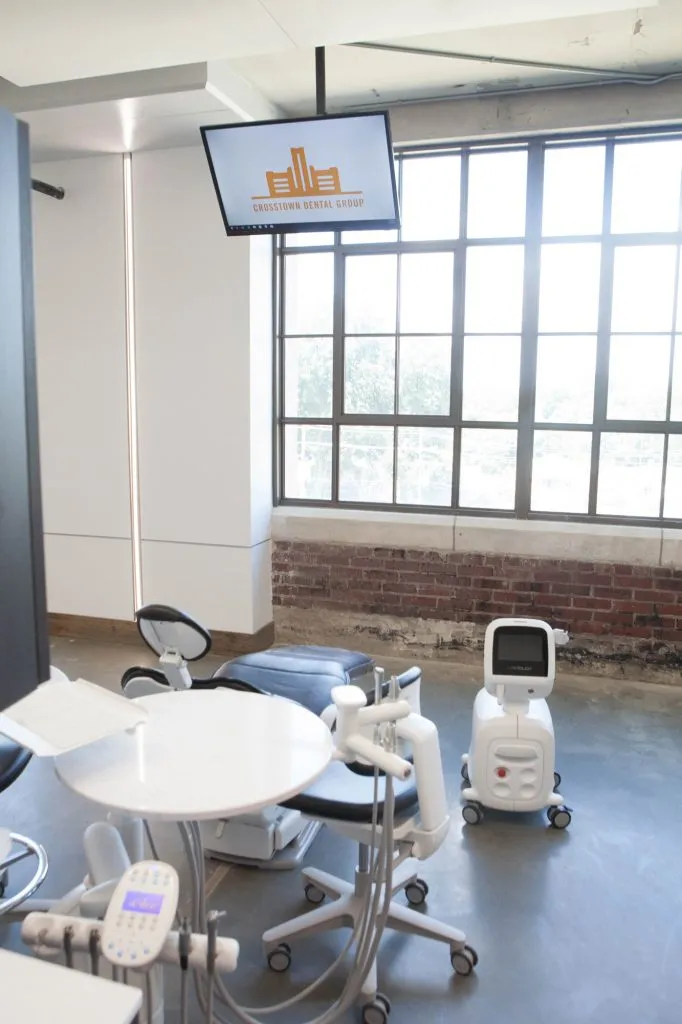
Laser treatment is not reserved for a single kind of problem - it is a versatile tool our dentists reach for whenever precision and patient comfort matter most. If you recognize any of the following, laser-assisted care may be the right fit for you, and our team can confirm during a consultation whether your case qualifies.
Not every laser is built for the same job, which is why Crosstown Dental Group maintains both soft tissue and hard tissue laser systems. Understanding the difference helps explain why your dentist might recommend one approach over another, depending on exactly what needs to be treated.
Soft tissue lasers are designed to work with gum tissue, cheek tissue, and the lining of the mouth. They penetrate tissue while simultaneously sealing blood vessels and nerve endings as they cut, which is why patients typically experience very little bleeding, minimal swelling, and reduced post-operative sensitivity. Hard tissue lasers, on the other hand, are engineered to cut through enamel, dentin, and bone - the materials involved in treating cavities, preparing a tooth for a filling, or performing certain bone-related procedures.
Patients who choose laser-assisted treatment at Crosstown Dental Group consistently report a more comfortable experience from start to finish. These benefits are not just about comfort in the moment - they carry through to healing time, long-term gum health, and how confident you feel walking into your next appointment.
One of the biggest advantages of laser dentistry is just how uneventful recovery tends to be. Most patients return to normal eating and speaking far sooner than they would after a traditional scalpel or drill procedure, though your dentist will still walk you through specific aftercare instructions based on what was treated.
Every laser procedure at Crosstown Dental Group is planned around your specific needs. While the exact steps vary slightly between soft tissue and hard tissue treatments, here is a general outline of what you can expect from your visit.
Your dentist examines the area of concern, reviews any imaging needed, and confirms whether a soft tissue or hard tissue laser is the right fit for your treatment goals.
Protective eyewear is provided, and in cases where a hard tissue laser is used near a nerve-sensitive area, your dentist will discuss whether any anesthetic is needed, often finding it is not.
The laser is used to remove decay, reshape tissue, or treat the targeted area with fine control, sealing vessels and nerve endings as it works on soft tissue.
Before you leave, your dentist reviews simple aftercare steps and lets you know what, if anything, to expect over the next day or two as the area settles.
Most patients report significantly less pain with laser treatment compared with traditional drills and scalpels. Many hard tissue laser procedures can be completed without any anesthetic injection at all, and soft tissue laser work typically involves minimal discomfort both during and after the procedure.
Soft tissue lasers are used on gums and oral tissue, sealing blood vessels and nerve endings as they treat or remove tissue, which reduces bleeding and swelling. Hard tissue lasers are designed to cut through enamel, dentin, and bone, and are primarily used to remove decay or prepare a tooth for a filling.
In many instances, hard tissue laser treatments can be performed without anesthetic because the laser generates less heat, vibration, and pressure than a traditional drill. Your dentist will always discuss this with you beforehand and will provide anesthetic if your specific procedure calls for it.
Recovery is typically much faster than traditional gum surgery. Because soft tissue lasers minimize bleeding and swelling and often avoid the need for sutures, most patients return to normal eating and speaking within a day or so, with only mild tenderness during healing.
Yes. Laser dentistry is well suited to children and anxious patients precisely because it reduces noise, vibration, and often the need for needles, which are among the biggest sources of dental anxiety. Our team evaluates each patient individually to confirm laser treatment is appropriate for their situation.
Coverage depends on the specific procedure performed and your individual dental plan, since laser treatment is often billed under the same procedure code as the traditional equivalent. Our front desk team is happy to review your coverage and walk through estimated costs before treatment begins.
Crosstown Dental Group
Comprehensive, comfortable dental care for every member of your family — schedule your appointment at Crosstown Dental Group today.

